Storage Solutions for Small Yoga Studios in 2026
Visual clutter increases cortisol and undermines professionalism. Here's how boutique operators are solving prop storage in 400-750 sq ft spaces.
Key Takeaways
- Storage design directly impacts student experience: Visual clutter increases cortisol levels and undermines the calm environment students expect, while organized prop systems communicate professionalism and care.
- Vertical solutions maximize tight footprints: Wall-mounted racks, pegboards, and floating shelves keep floor space clear in studios sized 400-750 square feet, where every square foot counts for class capacity and flow.
- Modular and custom systems are gaining traction: Providers like Mache and Seer Goods offer flexible prop storage that accommodates diverse equipment needs while reinforcing studio brand identity.
- Economic pressure is driving smaller, intentional spaces: With urban studio rents ranging from $2,500 to $15,000 monthly, boutique operators are optimizing tighter footprints to improve unit economics while maintaining 15-25% margins.
- Prop management affects operational efficiency: Student bottlenecks at prop closets and scattered equipment disrupt class flow, directly impacting the studio's ability to maximize revenue per square foot.
Why Storage Has Become a Critical Studio Design Challenge
As boutique yoga studios adapt to rising operating costs in 2026, storage is no longer an afterthought. It has become a core operational concern that directly affects member experience, class capacity, and profitability. Urban studio rents now range from $2,500 to $5,000 monthly for suitable spaces, with prime locations commanding $8,000 to $15,000 or more, pushing operators toward smaller, more intentional footprints.
The shift is strategic. Studios between 400 and 750 square feet can accommodate 10 to 30 clients while maintaining the intimacy and instructor connection that define boutique experiences. But in these tight spaces, poor prop storage creates immediate problems: students bottleneck at closets before class, scattered blocks and straps disrupt flow, and visual chaos undermines the calm atmosphere students pay for.
The Psychology and Professionalism of Organized Storage
Studies show that visual clutter increases cortisol, the body's stress hormone, which directly contradicts the nervous system regulation students seek in yoga practice. When props are scattered across the floor or piled haphazardly in corners, it signals disorganization and lack of care. When they are neatly stored and easily accessible, it communicates professionalism.
This perception matters for business outcomes. The United States has an estimated 40,000+ standalone yoga and Pilates studios competing for students in crowded markets. In an industry where experience and atmosphere drive retention and pricing power, the visual and functional quality of prop storage becomes a tangible brand signal.
How Clutter Disrupts Class Flow
Beyond aesthetics, poor storage creates operational friction. Studio operators report student bottlenecks at prop closets before and after class, which compresses class transitions and limits schedule density. When instructors need to stop mid-cue to clear scattered blocks from walkways, it breaks teaching rhythm and dilutes the member experience studios work to cultivate.
Five Storage Solutions Emerging in Small-Space Studios
As operators optimize for smaller footprints, several storage approaches have proven effective for managing props without sacrificing floor space or aesthetic quality.
Wall-Mounted Vertical Storage
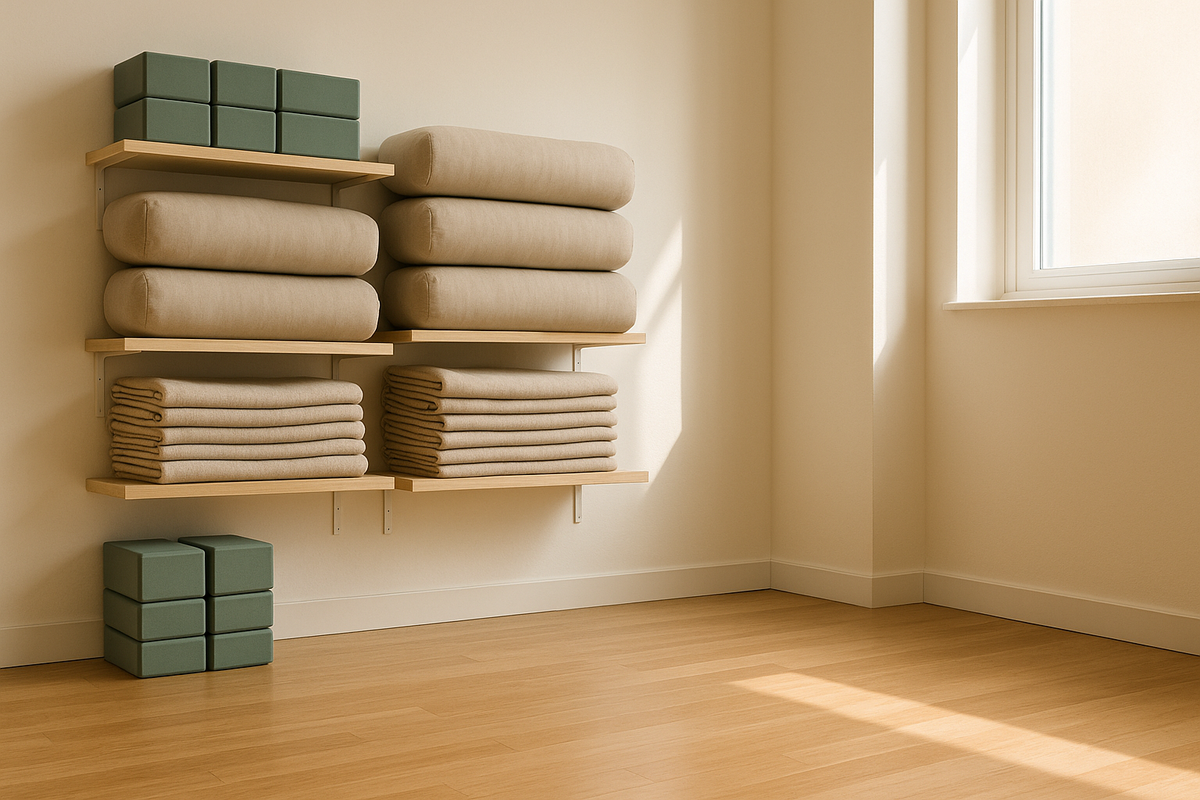
Simple pegboards or rows of hooks can hang mats, straps, and towels vertically, while slim floating shelves hold folded blankets and blocks. Wall-mounted racks keep mats clean and organized while adding visual style, and they can be installed at any height to accommodate different user needs. This approach is particularly effective in studios where floor space is the most valuable asset.
Modular and Custom Prop Systems
Flexible storage solutions that accommodate a range of props, from yoga mats to restorative bolsters, are gaining traction among boutique operators. Providers like Mache work with studios to realize custom design solutions that express each studio's unique brand aesthetic while solving specific prop management challenges. Custom systems typically cost $2,000 to $10,000 or more for a small studio, but they deliver long-term value through improved member experience and operational efficiency.
Hybrid and Multi-Purpose Furniture
Fold-down desks and furniture that serve dual purposes allow studios to maximize space utility. In hybrid studios that offer both in-person and digital programming, furniture that can transition between teaching, retail display, and storage becomes particularly valuable. This flexibility supports the trend toward studios offering combined membership models that an estimated 62% of boutique fitness operators are expected to adopt by 2026.
Rolling and Portable Solutions
Rolling carts with multiple tiers offer easy mobility, allowing instructors to move props efficiently between teaching spaces or storage areas. This approach works especially well in studios that host different class formats throughout the day, from slow-flow vinyasa to hot Pilates, each requiring different prop configurations.
Baskets and Bins
Fabric and wire baskets keep props tucked away without consuming excessive floor space. Wire baskets provide a modern aesthetic and often include handles for mobility, while fabric options offer flexibility in tight corners. Both approaches help studios maintain visual calm while ensuring props remain accessible.
Design Principles for Maximizing Small Studio Footprints
A smaller footprint doesn't mean a compromised experience—some of the most serene studios in the world are compact spaces where every design decision is intentional. The key is treating vertical space as primary real estate and floor space as the constraint to protect.
If space allows, zoning reception and retail areas away from the main practice room protects the quiet atmosphere students expect. This separation also prevents prop storage from bleeding into lobby areas, which can undermine the professional first impression that drives trial-to-member conversion.
How Storage Fits Into Studio Economics
Storage investments are not purely aesthetic. They directly support the operational efficiency needed to maintain healthy margins in competitive markets. Studios targeting 15-25% margins in urban markets must optimize every square foot for revenue-generating activity, which means props cannot consume valuable floor space or disrupt class transitions.
Mindbody's wellness industry research tracks three dominant studio types in 2026: vinyasa and slow-flow studios with lower fit-out costs, hot yoga and hot Pilates studios with high fit-out and premium pricing, and donation-based community studios. The low-fit-out vinyasa model pairs naturally with small-space design, but all formats benefit from prop systems that reduce setup time and protect class flow.
What This Means for Studio Operators
Editorial analysis, not reported fact:
Storage is a leverage point. In tight urban markets where every square foot carries rent burden, prop organization affects both member perception and schedule density. Operators should audit current prop flow by observing actual student behavior during transitions—where do bottlenecks occur, what gets left on the floor, which items are hardest to access?
Custom storage systems represent a capital investment, but they deliver returns through reduced class transition time, improved student experience, and stronger brand signal. For studios in the 400 to 750 square foot range, vertical solutions should be the default starting point, with modular systems considered for studios managing diverse class formats or planning to expand offerings over time.
The decision between off-the-shelf racks and custom solutions often comes down to brand positioning. Studios competing on premium experience and charging top-quartile pricing should view custom storage as part of the brand investment, similar to flooring or lighting. Studios optimizing for cost efficiency can achieve strong results with thoughtfully implemented wall-mounted systems and well-chosen baskets.
Sources & Further Reading
- Glofox Yoga Trends Report, covering hybrid membership adoption and industry forecasts
- Mariana Tek guide to designing inspiring yoga studios, including zoning and spatial principles
- Dojo Business analysis of yoga studio market trends, tracking studio types and economics
- Mache yoga storage solutions overview, featuring modular and custom design approaches
- Yune Yoga creative mat storage ideas, with practical wall-mounted and vertical options
- Yoga Union on improving prop storage areas, discussing clutter psychology and operational flow
- Vibe Family cost analysis for starting a yoga studio in 2026, including rent ranges and margin targets
- The Complete Athlete Guide to small yoga studio ideas, covering size recommendations and capacity
Editorial coverage of publicly reported industry developments. Yoga Studio Insider has no commercial relationship with any companies named.