Yoga Props in 2026: Sustainability and Specialized Equipment
The yoga accessories market grows 8.2% to $25.69B in 2026, with specialized props, sustainable materials, and online wholesale reshaping studio purchasing.
Key Takeaways
- Yoga props market growth: The yoga accessories market will expand from $23.74 billion in 2025 to $25.69 billion in 2026 at an 8.2% CAGR, with specialized props (blocks, straps, bolsters) emerging as the fastest-growing segment at 8% CAGR driven by injury prevention and accessibility needs.
- Sustainability drives commercial advantage: Eco-friendly materials now capture 52% of the props market, with clients actively gravitating toward studios using sustainable equipment from brands like Manduka, Sūna, and Complete Unity Yoga.
- Online purchasing dominates: In 2023, online sales represented 60% of the yoga equipment market versus 40% offline, with wholesale platforms offering mix-and-match options, low minimum order quantities, and next-day delivery lowering restocking barriers for studios.
- Frequent practitioners over-index: Those who work out most frequently over-index in buying yoga accessories by 13 points, making regular studio clients a high-value equipment recommendation opportunity.
- Tech-enabled props emerge: Smart mats with posture tracking and real-time feedback (such as YogiFi's pressure-sensor system) are entering the market, creating new opportunities for studios to differentiate on technology integration.
- Bulk purchasing sustains studios: Yoga studios provide a steady revenue base for equipment suppliers through bulk purchases, with the props market forecast to reach USD 2.5 billion by 2033 at 9.5% CAGR.
Why Specialized Props Are Outpacing General Equipment in 2026
The yoga equipment landscape is shifting decisively toward specialized props. Specialized props including yoga blocks, straps, and bolsters are the fastest-growing segment, driven by increased awareness of injury prevention, accessibility needs, and the rise of personalized practice routines. Yoga blocks alone project an 8% CAGR during the forecast period, outpacing general mat and apparel growth.
This shift reflects a broader pedagogical trend: instructors are moving from generalized mat-based flows toward therapeutic, alignment-focused teaching that requires props to accommodate varying body types, experience levels, and physical limitations. Yoga and Pilates participation increased from 13% to 17% in exercise routines, creating a larger addressable market for studios to serve with appropriate equipment.
Those who work out most frequently over-index in buying yoga accessories by 13 points, according to CivicScience's 2026 fitness trends analysis. For studio operators, this means regular clients represent not only recurring class revenue but also high-probability equipment purchasers who will respond to in-studio retail displays and informed prop recommendations.
Sustainability as Commercial Imperative, Not Marketing Add-On
Eco-friendly material subsegments now capture 52% of the yoga equipment market due to a pronounced consumer shift toward sustainable purchasing decisions. This is not aspirational positioning but observable buying behavior reflected in commercial sales data. Clients are gravitating toward eco-conscious fitness businesses, including those using sustainable materials for yoga mats, blocks, and apparel, per WOD Guru's 2026 yoga trends analysis.
Leading sustainable brands include Manduka, whose eKo collection uses sustainably-sourced rubber from rubber trees, and Sūna (founded 2021), which produces mats from natural rubber and recycled materials. Complete Unity Yoga was created by yoga teachers frustrated with the lack of sustainable and stylish equipment available, signaling that product-market fit exists specifically for instructor-informed sustainable design.
Ananda Hum, an official supplier recognized by the Spanish Iyengar Yoga Association since early 2025, offers wooden yoga blocks to organic cotton bolsters crafted from sustainable materials, demonstrating how lineage-based yoga communities are formalizing equipment standards around environmental criteria. For US studio operators, carrying certified sustainable props can function as both values alignment and client acquisition strategy in markets where environmental consciousness drives studio selection.
How Online Wholesale Is Reshaping Studio Equipment Purchasing
In 2023, online sales dominated the yoga equipment market with a 60% share, while offline sales made up 40%, with the online channel projected to grow at the fastest rate due to increasing adoption of e-commerce and direct-to-consumer models. For studio operators, this translates to expanded access to wholesale pricing, mix-and-match customization, and compressed procurement timelines.
Yoga studios provide a steady revenue base for suppliers through bulk purchases, making studios priority customers for wholesale platforms. These platforms now offer mix-and-match options with low minimum order quantities and next-day delivery, per industry supplier research, lowering the capital barrier to restocking or adding new prop categories mid-quarter rather than requiring annual bulk orders.
The yoga accessories market will grow from $23.74 billion in 2025 to $25.69 billion in 2026 at a compound annual growth rate of 8.2%, according to Coherent Market Insights. This growth is partly driven by studios upgrading equipment to meet client expectations shaped by online yoga consumption, where production-quality props are visible in every frame.
Material Innovation and Quality Standards Instructors Should Know
Current buying trends favor quality over quantity, sustainability as a primary concern, professional standards with home practitioners wanting studio-quality equipment, therapeutic applications with growing use of yoga for health and healing, and aesthetic integration as props enhance home decor, per Metadesk Shop's 2026 buyer's guide.
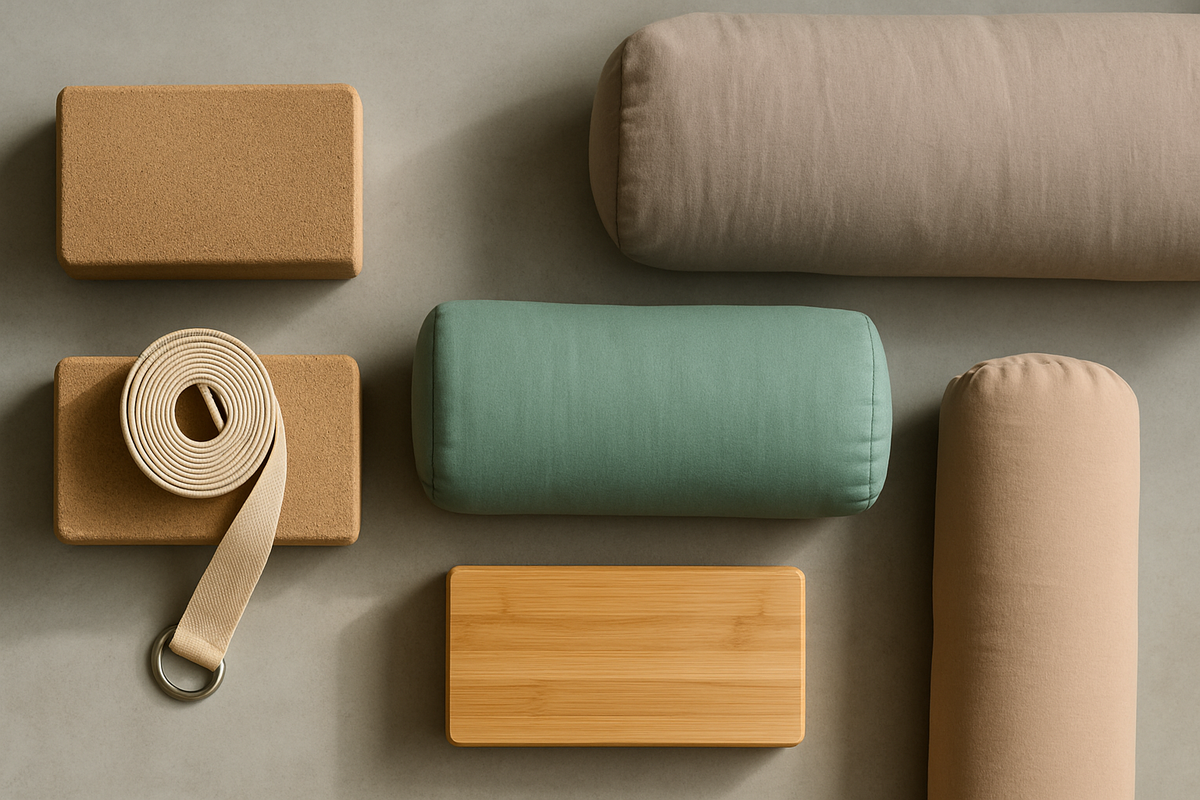
This quality-first orientation means studios can justify higher upfront equipment costs by emphasizing durability and therapeutic appropriateness rather than competing on price. Cork, bamboo, and high-density foam blocks each serve different use cases: cork provides weight and stability for restorative sequences, bamboo offers hardness for weight-bearing poses, and foam remains essential for travel workshops and beginners concerned about prop weight.
Smart mats and other tech-enabled accessories are emerging, offering features like posture tracking and personalized feedback. YogiFi integrates pressure sensors, motion tracking, and real-time feedback in an intelligent yoga mat system paired with studio classes, enabling students to self-correct poses, according to Glofox's trend analysis. While adoption remains early-stage, studios targeting corporate wellness clients or physical therapy referrals may find tech-enabled props create measurable outcomes data that supports insurance reimbursement or corporate contract renewals.
New Brands and Market Entrants to Watch in 2026
There are 22 yoga startups with an aggregate funding of $664.3 million, averaging $30.2 million per company, signaling venture capital interest in yoga industry infrastructure beyond studio operations. Notable 2025–2026 developments include FitLab expanding its portfolio by acquiring Y7 in February 2025, a yoga brand recognized for its music-driven and heated Vinyasa experience, with Y7 handing over nine studios to FitLab.
Love My Mat, a women-led, mother-daughter team, creates handcrafted yoga and meditation accessories from their studio in Hamilton, Ontario, using reclaimed fabrics and eco-friendly materials, demonstrating how artisan-scale equipment makers can differentiate on storytelling and local production. For US studios near the Canadian border or those emphasizing North American–made goods, cross-border sourcing from certified B Corps or women-owned manufacturers can enhance brand positioning.
Brands are becoming more conscious of inclusivity and body positivity, offering a wider range of sizes, styles, and colors to cater to diverse needs, per Coherent Market Insights. This extends to props: bolsters now come in varied widths and firmness levels, and straps are available in lengths beyond the standard 6-foot and 8-foot options to accommodate taller practitioners or those using straps for traction therapy rather than passive stretching.
The Home Practice Equipment Feedback Loop Affecting Studio Standards
The proliferation of online yoga classes and streaming services has democratized access to yoga, making it more accessible across socioeconomic and geographic boundaries. This digital shift encourages consumers to invest in home-based accessories, creating a direct link between virtual engagement and tangible product sales, according to industry analysis. Studios now face clients who own premium home props and expect studio equipment to meet or exceed that standard.
Studios are responding by offering eco-friendly equipment and yoga props, or even offering rentals for clients who may not have their own. Equipment rental programs serve dual purposes: lowering the barrier for drop-in clients while creating a trial-to-purchase funnel for regular attendees who prefer the studio's curated prop selection over consumer-grade options.
The yoga props market stood at USD 1.2 billion in 2024 and is forecast to reach USD 2.5 billion by 2033, registering a 9.5% CAGR, per Verified Market Reports. This growth trajectory reflects not just more practitioners but higher per-practitioner equipment spending as yoga evolves from mat-only practice to prop-supported, therapeutically informed movement education.
What This Means for Studio Owners
Editorial analysis — not reported fact:
The convergence of 8.2% market growth, 52% client preference for sustainable materials, and 60% online purchasing dominance creates three concrete commercial opportunities for studio operators in 2026. First, equipment budgets should shift toward specialized props (blocks, bolsters, straps) rather than mat inventory, as props support higher-margin therapeutic and accessibility-focused programming. Studios can justify 15–20% higher prop budgets by tying purchases to specific workshop series or teacher training modules that require specialized equipment.
Second, sustainable materials are no longer a premium positioning strategy but table-stakes client expectation. Studios replacing equipment this year should prioritize Manduka, Sūna, Complete Unity Yoga, or other certified sustainable brands, then communicate material sourcing explicitly on studio websites and in-class announcements. This is not aspirational branding; it is responding to the 52% majority preference observable in purchase data.
Third, wholesale purchasing has fundamentally changed. Studios no longer need to commit to annual bulk orders or maintain costly prop storage. Low-minimum, next-day-delivery wholesale platforms allow studios to restock props quarterly based on actual wear patterns and to experiment with new prop categories (like cork versus bamboo blocks) without capital risk. For studios operating in leased spaces with limited storage, this operational shift may matter more than any single equipment decision.
Finally, the 13-point over-indexing of frequent exercisers in accessory purchases suggests studios should treat prop retail as a client retention tool, not just ancillary revenue. Instructors who can articulate why a studio recommends a specific block material or bolster firmness for a client's individual practice create expertise-based selling that builds loyalty and increases lifetime client value beyond class packages alone.
Sources & Further Reading
- Yoga Props Market Report, Verified Market Reports — Market size, growth projections, and specialized props segment analysis
- Yoga Accessories Market Insight, Coherent Market Insights — Eco-friendly materials market share, online versus offline sales breakdown, and inclusivity trends
- Fitness Trends of 2026, CivicScience — Yoga participation growth and frequent exerciser purchasing behavior
- Yoga Trends 2026, WOD Guru — Sustainability in studio operations, new brand profiles, and eco-conscious client behavior
- Yoga Industry Trends, Glofox — Startup funding data, tech-enabled props like YogiFi, and Y7 acquisition details
- Best Yoga Blocks 2026 Buyer's Guide, Metadesk Shop — Quality standards, material comparisons, and therapeutic application trends
- Manduka Yoga Bolsters Collection — Sustainable material sourcing and eKo product line details
Editorial coverage of publicly reported industry developments. Yoga Studio Insider has no commercial relationship with any companies named.