Waivers, Scope Collapse & the PT Border Wars: New Rules
Yoga Alliance tightened scope standards in October 2025, hands-on adjustments face rising litigation, and insurance is now a hiring prerequisite. What changed and why it matters.
Key Takeaways
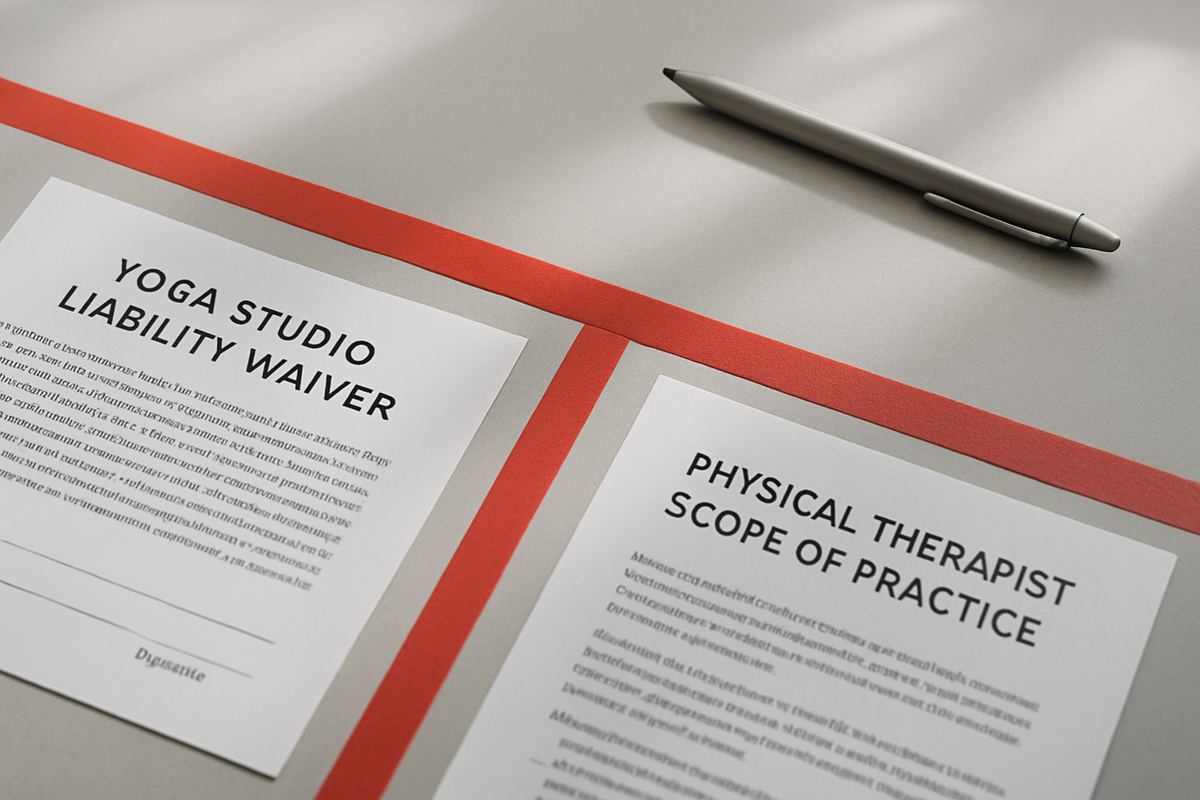
- Liability waivers reduce but do not eliminate risk for yoga studios and instructors; waivers cannot protect against gross negligence or reckless disregard for student safety, and they cover only activities explicitly described in the signed document.
- Yoga teacher insurance now costs $100–$200 annually and has become a prerequisite for employment at most studios, gyms, and retreat centers, with cyber liability coverage emerging as the fastest-growing policy category in 2026.
- Yoga Alliance tightened scope-of-practice standards in October 2025, prohibiting members from providing advice or services for which they lack proper licensure and clarifying that RYT and RYS designations do not credential yoga therapy techniques or the diagnosis and treatment of injuries.
- Hands-on adjustments represent a rising liability flashpoint, with instructors facing lawsuits even when adjustments are well-intentioned; physical assists can lead to muscle tears or joint injuries regardless of teacher intent.
- The yoga-versus-physical-therapy credentialing divide creates boundary confusion; yoga therapists require 800 hours of specialized training beyond 200-hour teacher certification, while physical therapists need clinical licensure before implementing yoga techniques in practice.
- Survey data shows 93% of yoga practitioners want clearer guidelines on what yoga professionals should teach versus what requires referral to medical or other licensed professionals.
Why Waivers Are Essential but Cannot Guarantee Protection
A yoga liability waiver serves as a legal document that reduces the risk of liability for yoga instructors and studios when participants face physical or emotional injury during class. Yoga Alliance recommends that studios have all students sign waivers, including those who have previously signed forms, to ensure coverage under updated terms.
The most critical limitation instructors must understand is gross negligence. Waivers will not cover studios or teachers if a court determines reckless disregard for safety or intentional harm. Additionally, waivers protect only the specific activities mentioned in the release form; studios may still face liability if a student is injured during an activity not clearly described in the signed document.
Because waiver enforceability varies by state, Yoga Alliance advises consulting with counsel in your jurisdiction to ensure compliance with applicable state laws. Expert practitioners recommend using both a waiver and insurance for the best protection: the waiver reduces legal risk, while insurance handles financial liabilities.
Insurance Requirements Tighten Across the Industry
Most yoga teacher insurance policies cost around $100–$200 per year as of mid-2026, though some providers charge more depending on coverage limits, location, teaching style, and whether instruction occurs in person, online, in workshops, retreats, or private sessions. For many instructors working within studios, yoga insurance has become a prerequisite to employment.
Many studios, gyms, retreat centers, and corporate clients now require proof of coverage before allowing instructors to teach. Some training programs even require yoga insurance for students learning to become professional instructors.
Cyber liability insurance has emerged as the newest and fastest-growing category in the yoga insurance market in 2026. Modern yoga businesses collect significant amounts of sensitive client data including payment information, health intake forms, injury histories, emergency contacts, and personal demographic details, creating new exposure to data breach and privacy violation claims.
Yoga Alliance Tightens Scope-of-Practice Standards in Late 2025
While yoga has existed for thousands of years, there is no single, universally shared scope of practice for yoga teachers as there is for instructors of other comparable activities such as Pilates or personal training. Because yoga teaching is a largely unregulated, unlicensed field, Yoga Alliance operates as a non-profit registry system with global membership but is not a governing body that regulates the yoga industry.
In October 2025, Yoga Alliance updated its standards to prohibit members from providing advice or services for which they are not properly and currently licensed during any program, including residential or immersion formats. Members may provide referral lists of locally available resources for students, including medical and mental health professionals, but unless the member is both competent and properly credentialed in the specific field in which they seek to provide services, they must gain competence and credentials, refer the student to a credentialed professional, or decline to provide such service or advice.
The updated standards explicitly state that Yoga Alliance credentials for Registered Yoga Schools and Registered Yoga Teachers do not credential yoga therapy techniques, including the diagnosis or treatment of mental or physical injury or illness. RYS, RYT, or YACEP designations may not be used to present oneself as qualified to work as a "yoga therapist" or to train others in "yoga therapy" methods. According to Yoga Alliance, a yoga teacher does not diagnose injuries, does not treat injuries, and does not prescribe rehabilitation plans.
Hands-On Adjustments Emerge as High-Risk Teaching Practice
Many yoga traditions involve physical assists, but a well-intentioned adjustment that leads to a muscle tear or joint injury can result in a lawsuit regardless of instructor intent. Hands-on adjustments carry some of the highest risks in yoga teaching as of 2026.
One illustrative case involved student Amalia Webster's claim against instructor Kurt Bumiller. She claimed injury after he placed a belt around her waist and pushed down on her lower back. While the case was ultimately dismissed, it demonstrates how physical adjustments can lead to lawsuits and how a proper waiver might have stopped the lawsuit before it started.
Even instructors who hold physical therapy licenses may want to avoid hands-on adjustments in group class settings because they lack sufficient information about each individual student's body and medical history to safely provide manual manipulation.
The Yoga Therapy and Physical Therapy Credentialing Divide
A yoga teacher or instructor can lead students in practicing yoga in a group class, while a yoga therapist works one-on-one with a client applying yoga techniques to specific health conditions. The International Association of Yoga Therapists (IAYT) has set the standard for yoga therapy training with a minimum of 800 hours of specialized instruction in addition to the prerequisite 200-hour yoga teacher training.
Physical therapists hold clinical licenses and work primarily with the body to treat conditions including hip pain, shoulder dysfunction, and back pain. PTs are especially valuable in helping patients recover from injuries or rehabilitate from surgeries. However, physical therapists should participate in yoga trainings or obtain yoga certifications prior to implementing yoga techniques in clinical practice.
Survey data shows that 93% of yoga practitioners and 86% of yoga professionals stated that better guidelines on what yoga professionals should teach and what should be referred to medical or other professionals was somewhat to very important, highlighting widespread recognition of the need for clearer boundaries.
Building Effective Referral Systems and Informed Consent Protocols
Studios can reduce liability exposure by establishing referral systems with local healthcare providers. When clients attend private sessions or yoga therapy appointments, intake forms should ask, "Who are the health professionals in this town that have helped you the most?" Making an effort to reach out to frequently mentioned health professionals and establishing connections often leads to cross-referrals and clearer boundaries around scope of practice.
Informed consent protocols should clearly communicate to students what services the instructor or studio can and cannot provide. This transparency helps manage student expectations and reduces the risk that students will rely on yoga instruction for medical diagnosis or treatment.
What This Means for Studio Owners
Editorial analysis — not reported fact:
The convergence of tighter Yoga Alliance standards, rising insurance requirements, and hands-on adjustment litigation creates a compliance squeeze for studio operators in the second half of 2026. Studios that treat waivers as one-time paperwork rather than annually updated legal documents are leaving themselves exposed, particularly as scope-of-practice standards have shifted materially in the past nine months.
The $100–$200 annual insurance cost is negligible compared to a single uninsured injury claim, yet the fact that this coverage has become an employment prerequisite suggests many studios are still hiring uninsured instructors. Owners should verify current proof of insurance for every teacher on the roster and add cyber liability coverage if the studio maintains any electronic client records or payment processing.
The October 2025 Yoga Alliance standards draw a bright line: if you are not licensed to diagnose, treat, or prescribe, you must refer out or decline to provide that service. Studios offering "yoga therapy" sessions led by 200-hour RYTs are now operating in direct conflict with registry standards. Either those instructors need the additional 800-hour IAYT certification, or the service needs to be renamed and repositioned to avoid implying therapeutic treatment of medical conditions.
On hands-on adjustments, the risk-reward calculus has shifted. Studios may want to adopt a verbal-cue-only policy for group classes and reserve any physical assists for private sessions where full intake forms, signed waivers, and deeper student history justify the additional risk. Even then, instructors who also hold PT licenses should consider whether the group class setting provides adequate information to safely adjust.
Finally, the 93% practitioner demand for clearer referral guidelines represents a business opportunity, not just a compliance burden. Studios that build visible referral partnerships with local physical therapists, mental health counselors, and registered dietitians signal professionalism, reduce instructor decision fatigue, and create reciprocal referral pathways that can drive new student enrollment.
Sources & Further Reading
- Yoga Alliance Standards and Registry — updated scope-of-practice standards effective October 2025, waiver recommendations, and RYT/RYS designation guidelines
- International Association of Yoga Therapists — 800-hour yoga therapy training standards and credentialing requirements
Editorial coverage of publicly reported industry developments. Yoga Studio Insider has no commercial relationship with any companies named.