Liability Reality Check: Waivers, Scope & Medical Referrals
Waivers reduce but don't eliminate risk. April 2025 Yoga Alliance guidelines now expect medical referrals. What teachers and studio owners must know about scope, insurance, and adjustments.
Key Takeaways
- Liability waivers reduce but do not eliminate risk: Waivers typically cover ordinary negligence but not gross negligence or reckless behavior, and courts may reject improperly drafted forms. Even when waivers hold up in court, studios still face legal defense costs.
- Dual-layer protection requires both waivers and insurance: General Liability covers property-related incidents while Professional Liability covers teaching-related injuries. Occurrence-form policies protect you even when claims are filed after your policy expires, critical since yoga injury claims often surface months or years later.
- No universal scope of practice exists for yoga teachers: Unlike physical therapists or Pilates instructors, yoga teachers have no standardized legal scope, creating confusion around hands-on adjustments, medical advice, and therapeutic claims. Scope varies by individual credentials and state law.
- Yoga Alliance released updated Scope guidelines in April 2025: The guidelines direct teachers to advise only within their credentials and experience, and recommend creating referral lists for medical professionals, mental health resources, and crisis hotlines for students who need care beyond yoga instruction.
- Medical advice and dietary recommendations are out of scope: Yoga teachers without healthcare licenses cannot legally diagnose injuries, prescribe treatments, or recommend specific diets or supplements. Doing so risks prosecution for unlicensed practice of medicine.
- Hands-on adjustments carry high litigation risk: Recent lawsuits involve unsolicited adjustments that allegedly caused permanent disabilities and spinal injuries requiring surgery. Teachers must obtain explicit consent and recognize when manual therapy crosses into physical therapy territory.
Why Liability Waivers Alone Won't Protect You
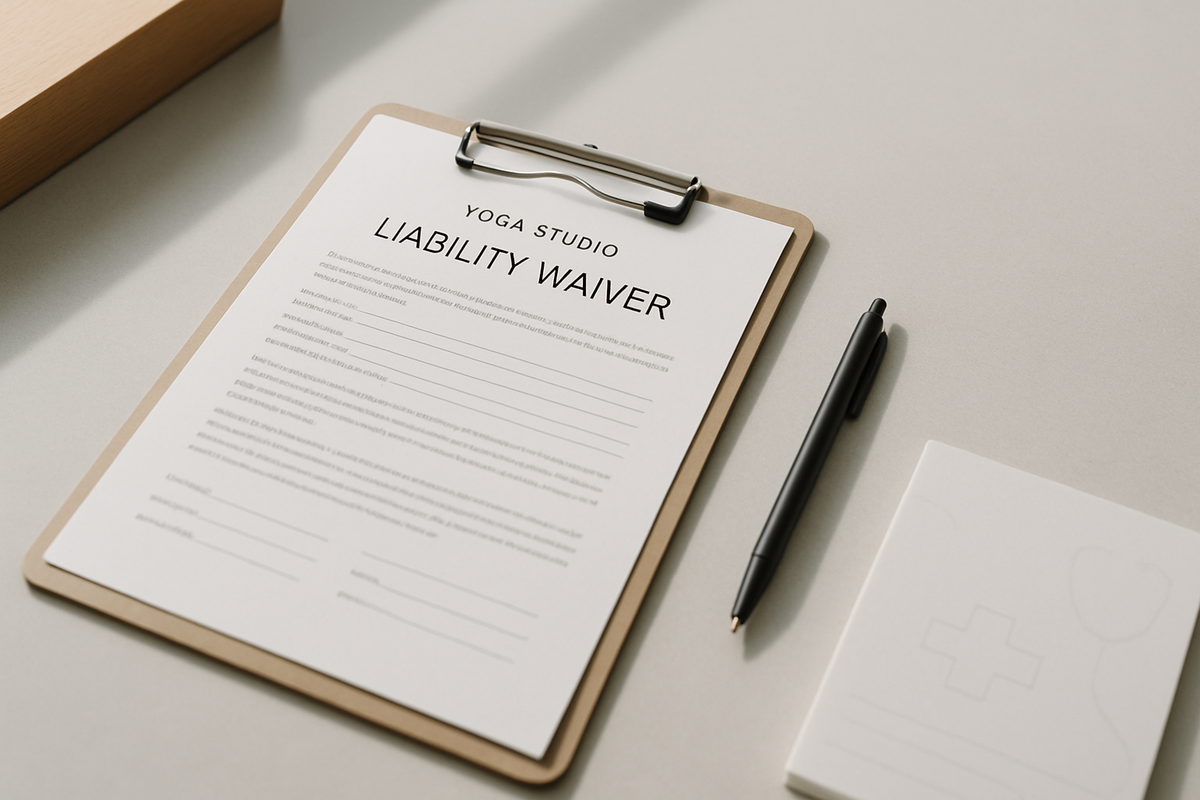
Liability waivers are legal agreements in which students acknowledge yoga's inherent risks and agree not to hold teachers or studios responsible for injuries sustained during class. While these documents provide some protection, their enforceability is far from absolute.
According to beYogi's analysis of waiver enforceability, waivers typically cover ordinary negligence but not gross negligence or reckless behavior. In the United States, whether a waiver holds up depends on state law, jury interpretation, and the specific language used in the document. Courts consistently reject waivers that attempt to shield truly negligent behavior from legal responsibility.
Even when a waiver is upheld in court, studios and teachers still face substantial legal defense costs. As beYogi notes in their liability guidance, you will still pay legal fees and other costs to defend yourself, expenses that add up quickly regardless of the outcome.
The Case for Dual-Layer Protection: Waivers Plus Insurance
Insurance industry guidance consistently recommends using both waivers and insurance together, as the waiver reduces legal risk while insurance covers financial liabilities when waivers fail or claims exceed their scope.
Two distinct insurance types serve yoga professionals. General Liability handles slips, falls, and property damage occurring on studio premises. Professional Liability (also called malpractice or errors and omissions insurance) covers injuries directly tied to your teaching, including adjustment-related injuries and allegations of providing advice beyond your scope.
Policy structure matters significantly. Occurrence-form policies provide coverage even after your policy expires. If an incident occurs in May 2025 during an active policy period but the claim is not filed until May 2026 after the policy has lapsed, an occurrence policy still covers you. This proves critical in yoga liability cases, which frequently surface months or years after the alleged incident as injuries worsen or students connect chronic problems to past classes.
The Scope of Practice Gap: No Standard Exists
Unlike physical therapists, massage therapists, or even Pilates instructors, yoga teachers in the United States have no universally recognized scope of practice. This creates a legal gray zone where individual credentials, state regulations, and jury interpretation determine what constitutes overstepping professional boundaries.
As Yoga Alliance's Scope of Practice resource explains, scope for different teachers varies depending on their educational backgrounds. A teacher who holds both a 500-hour yoga certification and a physical therapy license with appropriate insurance may legally perform manual adjustments in private sessions. A teacher with only a 200-hour yoga teacher training cannot perform the same adjustments, even if adjustment techniques were taught in their yoga training, because they lack a license authorizing therapeutic touch.
According to Yoga Alliance guidance, the organization's certification is not a legal requirement to teach yoga, as the industry remains largely unregulated. This regulatory vacuum leaves individual teachers vulnerable to enforcement actions when they drift into medical territory.
April 2025 Yoga Alliance Guidelines: Medical Referrals Now Expected
In April 2025, Yoga Alliance released updated Scope of Practice guidelines that clearly define the yoga teacher role, including specific responsibilities, limitations, and professional boundaries. The guidelines direct teachers to advise and teach only according to their credentials, experience, and abilities.
A significant new expectation involves medical and mental health referrals. The April 2025 guidelines state that Yoga Alliance members should create and provide referral lists of locally available resources for students, including medical and mental health professionals, law enforcement, suicide prevention hotlines, sexual abuse hotlines, and Yoga Alliance itself.
This referral expectation acknowledges what legal experts have long advised: yoga teachers are not licensed to give medical advice in most health areas. As the Scope resource notes, even well-intended health advice can cross the line into unlicensed practice of medicine, psychology, or other regulated disciplines. The role of yoga teachers is to guide students through practices of movement, breath, awareness, and mindfulness, not to diagnose injuries, prescribe treatment, or act as therapists or medical professionals unless they hold those specific credentials.
Where Medical Advice Becomes Unlicensed Practice
The boundary between sharing yoga philosophy and practicing medicine without a license can be surprisingly narrow. Dietary recommendations represent a common violation area.
According to Yoga Alliance's scope guidance, unless you are a registered dietician or other medical professional with appropriate training and licensure, recommending specific diets, cleanses, foods, or supplements to students falls outside your scope of practice. Students asking specific nutrition questions are best served by referral to a registered dietician or similar licensed professional.
The regulatory threat extends beyond individual liability. A Yoga Alliance legal statement on yoga therapy warns that without an appropriately defined scope of practice and necessary state authorizations, increasingly popular therapeutic methods invite enforcement actions for unlicensed practice of medicine. State boards of medicine may seek prosecution of unregulated practitioners, and such enforcement could sweep the entire yoga community under restrictive regulatory schemes.
The statement also cautions that yoga therapists lacking training in physiology, anatomy, pathology, or mental health could cause more harm than good to clients, creating both ethical violations and liability exposure.
Hands-On Adjustments: Where Most Lawsuits Originate
Physical adjustments during yoga classes generate disproportionate litigation risk. Recent lawsuits illustrate the severity of potential consequences.
Cases documented in industry legal resources include a man who sued a yoga studio after an unsolicited pose adjustment allegedly led to injury resulting in permanent disability, and a woman who alleged that an improper adjustment led to serious spinal injury requiring major surgery. These cases underscore that yoga teachers are legally, ethically, and professionally obligated to exercise due care in teaching and any adjustments they perform.
The boundary between yoga adjustments and physical therapy manual therapy remains legally contentious. As discussed earlier, a teacher with only yoga training who performs hands-on corrections may be practicing physical therapy without a license, particularly if the adjustment targets a specific injury or therapeutic goal rather than general postural guidance.
Communication failures amplify adjustment risks. According to professional liability research cited by Yoga Alliance, many malpractice lawsuits stem from an injury combined with perceived negligence, often exacerbated by the provider's failure to adequately communicate with a concerned client. Miscommunication between providers and patients accounts for many malpractice filings. The physical and psychological intimacy of yoga classes demands particular vigilance around students' moment-to-moment receptivity to changing levels of contact, both physical and energetic, from instructors.
The Injury Data: 29,590 Emergency Department Visits in 13 Years
Between 2001 and 2014, hospital emergency departments in the United States recorded 29,590 yoga-related injuries, according to research published in the Orthopedic Journal of Sports Medicine. While this spans more than a decade and represents a tiny fraction of the millions practicing yoga during that period, the data confirms that serious injuries do occur and generate both medical costs and legal exposure.
These documented injuries provide plaintiffs with medical records that can support negligence claims, particularly when combined with allegations of inadequate instruction, failure to warn about risks, or adjustments performed without consent or proper training.
What This Means for Studio Owners
Editorial analysis, not reported fact:
The April 2025 Yoga Alliance guidelines signal that the era of yoga operating in a self-regulated vacuum is ending. Studios and independent teachers who treat scope of practice as an abstract concept rather than a legal boundary face mounting enforcement and litigation risk in 2026 and beyond.
Practical steps include implementing digital waiver systems (all 50 states accept electronic signatures), securing both General and Professional Liability insurance with occurrence-form coverage, and creating curated referral lists for medical providers, mental health professionals, registered dieticians, and physical therapists. Train your teaching staff to recognize the language that crosses into medical advice: "this pose will heal your herniated disc" versus "some students find this pose helpful for back discomfort, but check with your doctor."
For hands-on adjustments, establish a studio-wide consent protocol. Some studios now use verbal permission requests before every adjustment, while others include adjustment consent as a separate item in intake forms with opt-out options. Given the litigation documented around unsolicited adjustments, a blanket "we don't adjust without asking" policy may prove the most defensible approach, even if it contradicts traditional teaching methods.
Studios employing teachers as independent contractors rather than employees face additional scrutiny. As labor classification guidance notes, a yoga instructor teaching classes at a yoga studio is performing work squarely within the studio's usual course of business, raising misclassification risks under current Department of Labor standards. Ensure your contractor agreements, insurance requirements, and scope-of-practice training align with your classification choices.
Finally, the absence of a universal scope standard means documentation becomes your primary defense. Incident reports, adjustment logs, student intake forms noting pre-existing conditions and physician clearances, and records of referrals made create a paper trail demonstrating reasonable care. In litigation, the question is rarely whether an injury occurred but whether the teacher or studio acted reasonably given what they knew. Documentation answers that question.
Sources & Further Reading
- Yoga Alliance Scope of Practice Resource — Comprehensive guidance on teacher responsibilities, boundaries, and the April 2025 updated scope guidelines
- beYogi Guide to Yoga Liability Waivers — Analysis of waiver enforceability by state and the limitations of waivers in protecting against negligence claims
- beYogi Explanation of Occurrence vs. Claims-Made Insurance — Detailed comparison of policy types and why occurrence coverage matters for yoga professionals
- Yoga Alliance Legal Statement on Yoga Therapy — Policy position on regulatory risks facing yoga therapists and the need for defined scope of practice
- Orthopedic Journal of Sports Medicine: Yoga-Related Injuries in the United States From 2001 to 2014 — Epidemiological study documenting 29,590 emergency department visits for yoga injuries over 13 years
Editorial coverage of publicly reported industry developments. Yoga Studio Insider has no commercial relationship with any companies named.