Capital-Backed Yoga Expansion & Hybrid Studio Models in 2026
Yoga Joint's $5.5M raise signals institutional confidence in hybrid formats. CorePower expands to Long Island. What the capital influx and design trends mean for independents.
Key Takeaways
- Capital-backed expansion: Yoga Joint secured $5.5 million in growth capital to open 15+ infrared yoga and strength studios across New York City by 2030, with flagship locations opening Fall 2026 in Manhattan and Williamsburg.
- Hybrid modality validation: Studios combining yoga with strength training and heat therapy are attracting institutional investment, signaling the format has matured from boutique experiment to scalable category with proven unit economics.
- Franchise market momentum: The yoga franchise sector is projected to grow from $2.7 billion in 2026 to $5.65 billion by 2035, driven by demand for accessible instruction and standardized quality across suburban and secondary markets.
- Experience-driven design: Studios like Y7 Studio are differentiating through sensory curation—candlelit rooms, hip-hop soundtracks, no mirrors—prioritizing psychological impact over traditional aesthetics to build cult followings.
- Sustainability as competitive advantage: Modo Yoga's eco-conscious "Green Studio" design and radiant heating systems position the brand for long-term retention in a market where 89% NPS reflects consumer alignment with ESG principles.
- Suburban expansion by majors: CorePower Yoga is opening two Long Island locations in late 2026, reflecting confidence in suburban demand and continued aggressive growth across premium markets with 220+ studios nationwide.
Why Capital Is Betting on Hybrid Yoga Formats in 2026
Institutional investors are now treating hybrid yoga concepts—studios that blend yoga with strength training and infrared heat—as a serious asset class. Yoga Joint's $5.5 million raise to fund its New York City expansion is the clearest signal yet that the "yoga plus" format has crossed from boutique trend to scalable category. The South Florida-born brand plans to open its first Manhattan location at 470 Park Avenue South and a Williamsburg studio at 267 Kent Ave in Fall 2026, with a target of more than 15 locations across the metro by 2030.
The deal structure reflects a strategic shift in how studio brands scale. Rather than franchising aggressively, the 2026 playbook favors corporate growth capital paired with flagship-market launches in high-density metros. This approach allows for tighter brand control, consistent design execution, and centralized operations—critical when experience differentiation drives customer acquisition.
The validation extends beyond Yoga Joint. SPENGA, which consolidates Spin, Strength, and Yoga into a single 60-minute session, reports average revenues of $670,755 per location and a Net Promoter Score of 92%, according to franchise disclosure data. The model capitalizes on "gym-stacking" behavior, where consumers previously held multiple boutique memberships to access different modalities.
How Major Chains Are Expanding Across Suburban and Secondary Markets
CorePower Yoga, the nation's largest yoga studio brand with more than 220 locations nationwide, continues its suburban push with two new Long Island studios opening in 2026: a Roslyn location launching in late summer and a Garden City site by year's end. The brand also opened a Del Mar Highlands studio in San Diego, its 15th in that market, per recent franchise industry reporting.
The aggressive expansion reflects confidence in suburban demand for fitness experiences that combine physical intensity, mindfulness, and community. CorePower's model—heated power yoga classes, sculpt formats, and tiered memberships—has proven resilient across economic cycles, and the suburban footprint allows for lower rent per square foot while capturing families and professionals seeking convenient wellness access.
Regional players are also making moves. Monarch Yoga is opening its third Philadelphia location in Fall 2026, following sites in Kensington and Northern Liberties. The brand emphasizes accessibility through tiered memberships and five-dollar classes, a pricing strategy designed to broaden the demographic base beyond the typical $18-to-$28 drop-in market.
Experience-First Interior Design and the Psychology of Studio Environments
In 2026, interior design is no longer an afterthought—it's a primary differentiator. Y7 Studio has built a cult following by stripping away traditional yoga aesthetics. Classes take place in dark, candlelit rooms with no mirrors and hip-hop soundtracks, allowing practitioners to focus on internal experience without self-judgment or comparison. The brand operates bicoastally with studios in New York, California, and Austin, Texas.
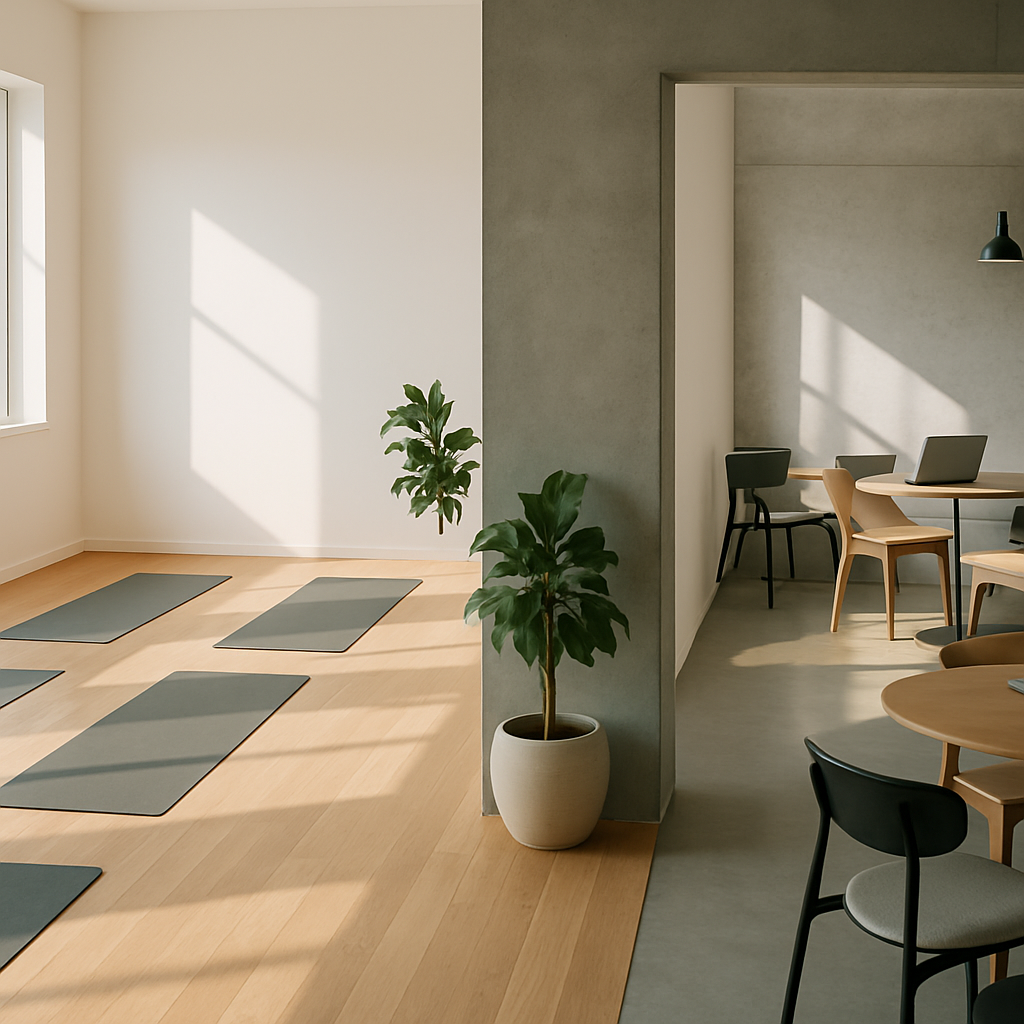
The design philosophy aligns with broader 2026 trends emphasizing calm, restorative interiors. Studios are incorporating reduced noise, softer forms, and dedicated spaces for meditation and quiet retreat. Lighting design, natural ventilation, and spatial flow are now as important as class programming, according to recent wellness design reporting.
Sustainability is also shaping material choices. Yoga studio visitors increasingly expect eco-friendly design, driving adoption of bamboo flooring, linoleum, natural stone, and recycled materials. Modo Yoga, an international chain of eco-conscious hot yoga studios, uses ethically sourced materials and radiant heating systems rather than forced air, which is more energy-efficient. The brand's "Green Studio" design principles contribute to an 89% Net Promoter Score and strong long-term retention.
Business Model Breakdowns: What Works in 2026 Unit Economics
Yoga studios operate as high fixed-cost, low variable-cost businesses. Profitability hinges on three variables: class utilization rate, revenue per square foot, and instructor cost as a percentage of revenue. Rent typically represents 20% to 30% of revenue, while instructor costs add another 25% to 35%, per industry unit economics analysis.
Three dominant models have emerged. The membership-led model delivers predictable revenue and strong retention when community loyalty is high. The drop-in/class pack model lowers commitment barriers for new clients but creates revenue volatility. Most established studios now use a hybrid approach, combining memberships with drop-in availability and add-ons like workshops, private sessions, and retreats to maximize both accessibility and revenue stability.
The franchise model is accelerating. The yoga franchise market is projected to grow from $2.7 billion in 2026 to $5.65 billion by 2035, driven by standardized quality, operational playbooks, and access to instruction in suburban and exurban markets where independent studios struggle to gain traction.
What This Means for Studio Owners
Editorial analysis—not reported fact:
If you operate an independent studio, the competitive landscape is intensifying. Capital-backed brands are entering your markets with superior build-out budgets, centralized marketing, and economies of scale on instructor training. Your competitive advantage now lies in hyper-local community ties, programming specificity (e.g., therapeutic yoga, prenatal, senior classes), and experience curation that cannot be replicated by a franchise playbook.
If you're considering expansion, scrutinize whether your model can support the fixed costs of multiple locations without diluting quality or straining cash flow. The Yoga Joint raise suggests that growth capital is available for concepts with proven unit economics and clear differentiation, but investors will demand evidence of retention, NPS, and revenue per square foot before committing.
For those designing or renovating spaces, prioritize sustainability and sensory experience. In a market where class content is increasingly commoditized (YouTube and Peloton offer free alternatives), the physical environment becomes a primary reason to pay $22 per class. Radiant heating, natural materials, acoustic treatment, and lighting design are not luxuries—they are table stakes for retention in 2026.
Sources & Further Reading
- Athletech News: Yoga Joint Secures $5.5 Million for NYC Expansion—details on capital raise, studio locations, and growth timeline
- Franchise Wire: Yoga Franchise Market Projected to Reach $5.65 Billion by 2035—market size, growth drivers, and franchise trends
- Franchise Wire: CorePower Yoga Expansion Across Suburban Markets—Long Island and San Diego openings, brand positioning
- SPENGA: Hybrid Fitness Model and Franchise Performance Data—revenue per location, NPS scores, and multi-modality approach
- Modo Yoga: Eco-Conscious Studio Design and ESG Principles—green building practices, radiant heating, and sustainability positioning
- Y7 Studio: Experience-First Design and Brand Differentiation—candlelit rooms, hip-hop yoga, and sensory curation
- Studio Growth: Yoga Studio Unit Economics and Profitability Analysis—cost structures, revenue models, and operational benchmarks
- Architectural Digest: Wellness Design Trends in 2026—interior design principles, lighting, and material choices
Editorial coverage of publicly reported industry developments. Yoga Studio Insider has no commercial relationship with any companies named.