Aerial Yoga: Equipment Costs, Training & ROI for Studios
Capital requirements range from $105K to $215K. Conservative models show Year 4 breakeven. Specialized insurance and 50-250 hour certifications are required.
Key Takeaways
- Startup capital requirements for aerial yoga range from $105,000 to $215,000, driven by professional rigging, specialized installation, and structural engineering consultations that are non-negotiable for safety and liability compliance.
- Instructor certification requires 50 to 250 hours of specialized training beyond standard yoga credentials, with in-person programs costing $1,200 to $1,550 and covering biomechanics, suspension principles, rigging safety, and risk management.
- Insurance coverage is a critical planning factor: standard yoga policies exclude aerial activities, requiring specialized high-risk underwriting and explicit listing of aerial yoga as a covered activity.
- Revenue models show average pricing of $34 per group class and $120 per private session, with conservative projections indicating breakeven in Year 4 and first-year revenue around $262,000.
- Profitability depends on geographic positioning, membership mix favoring unlimited packages over drop-ins, and treating social content production as infrastructure rather than marketing afterthought.
The Capital Math: Why $100,000 Is Just the Starting Point
Studios evaluating aerial yoga as a specialization face a fundamentally different capital structure than adding mat-based formats. Full studio buildout requires approximately $105,000 in capital expenditure, with the largest line item being professional rigging and structural modifications. More comprehensive models that include posture-tracking technology push the total to $215,000 when combining $120,000 for rigging and professional installation with $95,000 for validation systems.
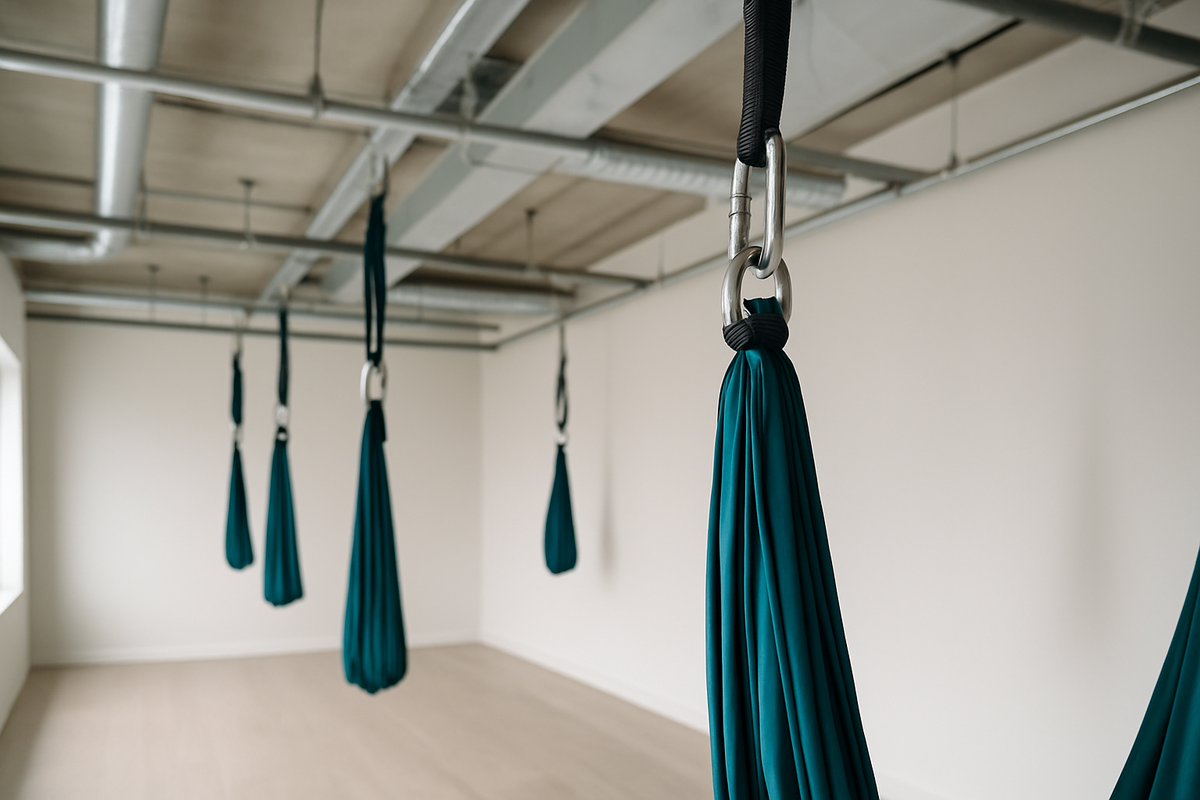
The critical cost driver is non-negotiable: structural engineering consultation and certified rigging installation. Structural engineers should always be consulted on aerial rigging projects, and this should never be considered an optional cost, as faulty installations create catastrophic liability exposure. Individual hammock kits may retail for around $300, but the infrastructure to suspend them safely at scale requires load-bearing certification, with anchor points rated to hold a minimum of 1,000 pounds.
Beyond buildout, fixed monthly operating expenses for four staff members reach nearly $30,650, requiring high utilization rates to cover overhead before achieving contribution margin.
Training and Certification: Beyond the Weekend Workshop
The instructor talent pipeline for aerial yoga requires substantially more investment than many studio operators anticipate. While mat-based yoga allows teachers to specialize incrementally, aerial demands comprehensive upfront credentialing. Training programs range from 80-hour Aerial Restorative Yin certifications to 250-hour comprehensive Aerial Yoga Teacher Training, with pricing spanning $1,200 early-bird to $1,550 for standard enrollment.
No universal accreditation standard exists, creating diligence burden for hiring managers. Earth & Aerial Yoga offers the only program accredited by the American Yoga Council, with their 60-hour Level 1 certification qualifying for Yoga Alliance continuing education credits. However, safe instruction requires mastery across multiple domains: biomechanics of inverted poses, suspension load distribution, spotting techniques for students in hammocks, and emergency descent protocols.
Studios cannot simply upskill existing 200-hour RYT instructors with a single weekend module. Qualified aerial teachers complete rigorous programs covering anatomy studies specific to inversion, safety protocols for equipment inspection and student screening, and specialized risk management training that standard yoga teacher training does not address.
The Insurance Obstacle Most Studios Discover Too Late
Aerial yoga insurance is a high-risk product, and most regular insurance carriers will deny coverage unless aerial yoga is specifically listed as a covered activity. This represents a structural cost and compliance requirement distinct from mat-based formats, where general liability policies typically provide baseline protection.
The underwriting complexity stems from suspended apparatus and inversion work. Faulty installations or improper anchoring can lead to serious accidents, and studio owners face unique risks with suspended rigs, aerial silks, and complex poses that standard yoga policies explicitly exclude. Compliance requirements cascade: students can be in the hammock at 12 feet above ground or lower for insurance qualification, though rigging itself can be higher, and ongoing certification maintenance for instructors often becomes a policy condition.
Studios must budget for specialized underwriting from carriers familiar with aerial disciplines, annual re-certification of rigging by licensed professionals, and instructor continuing education documentation that satisfies carrier requirements. These represent ongoing operational costs, not one-time expenses.
Revenue Models and the Breakeven Timeline
Pricing power for aerial classes exceeds standard formats. The average cost is $34 per group class and $120 per private session, with typical ranges between $20-$48 per class or $75-$165 for private training. The visual novelty and specialized equipment allow studios to command premium positioning, and specialized classes like aerial yoga can often justify higher fees than more generic entry-level classes.
However, profitability timelines vary dramatically based on utilization assumptions. Optimistic models project breakeven in the first month and first-year EBITDA of $383,000, but these rely on occupancy rates exceeding 400 percent that are unattainable without multiple simultaneous class slots or extremely high private session volume. Conservative projections show breakeven in Year 4 with Year 1 revenue of $262,000.
Revenue optimization requires membership structure discipline. Focusing on high-margin recurring revenue like unlimited memberships at $155 per month versus lower-yield drop-in sales at $29 per unit is critical for covering fixed overhead. Successful operators achieve profit margins around 10 to 20 percent by leveraging diversified revenue streams including workshops, retail, and tiered membership models rather than relying solely on per-class fees.
Market Positioning and the Geographic Question
Aerial yoga occupies a specialized segment within the broader yoga market. Yoga classes generated approximately $71.5 billion in 2025, with various types ranging from traditional Hatha and Ashtanga to modern power yoga and aerial yoga, indicating aerial is one of many differentiated offerings rather than a dominant category. Specialized yoga studios catering to niche interests like aerial yoga are expanding their market segments, but demand concentration varies sharply by geography and demographic.
Urban high-income markets demonstrate proven demand but face saturation and competitive intensity. In urban centers where demand is high, owners can achieve annual earnings that often exceed $100,000, but these markets typically already have established aerial providers. Suburban and secondary markets face longer customer education cycles and lower willingness to pay premium pricing, extending the capital recovery timeline.
The visual nature of aerial creates a content advantage for studios willing to invest in production infrastructure. Instagram and TikTok are essential for aerial yoga studios as top-of-funnel engines that seed awareness, and studios growing fastest in 2026 treat social content as a production priority. However, this requires consistent high-quality output, not sporadic posting, and behind-the-scenes setup and rigging content builds trust and answers the silent safety question every new student has.
What This Means for Studio Operators
Editorial analysis, not reported fact:
Aerial yoga represents a viable specialization path for studios with three critical prerequisites: capital reserves sufficient to absorb $100,000-plus in non-recoverable buildout costs, positioning in affluent urban markets with demonstrated demand for premium specialty formats, and existing operational scale of 500-plus active members to provide a conversion base. Studios lacking any of these three foundations should prioritize membership growth and operational efficiency in existing formats before considering aerial expansion.
The training and insurance requirements create genuine barriers to entry, which can protect market position once established but also mean that partial commitment fails. Studios cannot test aerial viability with minimal investment; the safety and liability infrastructure requires full buildout from day one. This makes aerial poorly suited for early-stage studios or those operating on thin margins, where a 12 to 48 month capital recovery period creates existential cash flow risk.
For established studios in strong markets, aerial offers legitimate differentiation and pricing power, but only if operators treat content production as core infrastructure rather than marketing afterthought. The format's visual appeal creates organic discovery advantages, but capturing that requires dedicated production workflows and instructor comfort on camera, which are distinct skill sets from teaching capability.
Sources & Further Reading
- Aerial Yoga Studio Startup Costs, comprehensive breakdown of capital requirements and monthly operating expenses
- Financial Models for Aerial Studios, buildout budgets including technology integration
- American Yoga Council Accredited Training, certification program details and Yoga Alliance continuing education eligibility
- Aerial Yoga Insurance Guide, coverage requirements and carrier selection for high-risk activities
- Aerial Yoga Rigging Safety, structural engineering consultation requirements and industry standards
- Aerial Studio Marketing in 2026, social content strategies and trust-building through transparency
Editorial coverage of publicly reported industry developments. Yoga Studio Insider has no commercial relationship with any companies named.